The Tractor Isn't Going Anywhere — But It Doesn't Need to Do Everything
Every farmer knows the tractor is the backbone of the operation. Plowing, discing, baling — nothing replaces it for heavy field work. But here's the question most farm operators don't ask often enough: how much of your day is actually spent on heavy field work?
For most livestock and mixed-crop operations, the answer is surprisingly low. Studies across European agricultural operations estimate that 70-80% of a farmer's daily driving involves tasks that don't require a tractor at all. Checking livestock in the morning. Inspecting fence lines after a storm. Hauling a few bags of feed or a roll of wire to a far pasture. Running between fields to check irrigation or drainage.
Every one of those trips in a tractor costs you time and fuel — and compacts the soil you're trying to keep productive. A 4,000 kg tractor driving across a wet pasture leaves ruts. A 400 kg ATV barely leaves a trace.
The math is straightforward. A tractor burns 8-15 liters of diesel per hour under light load. An ATV burns 3-5 liters doing the same task in half the time. Over a year of daily rounds, that difference adds up to thousands of euros saved.
Top Farm Use Cases for ATVs
Livestock Management
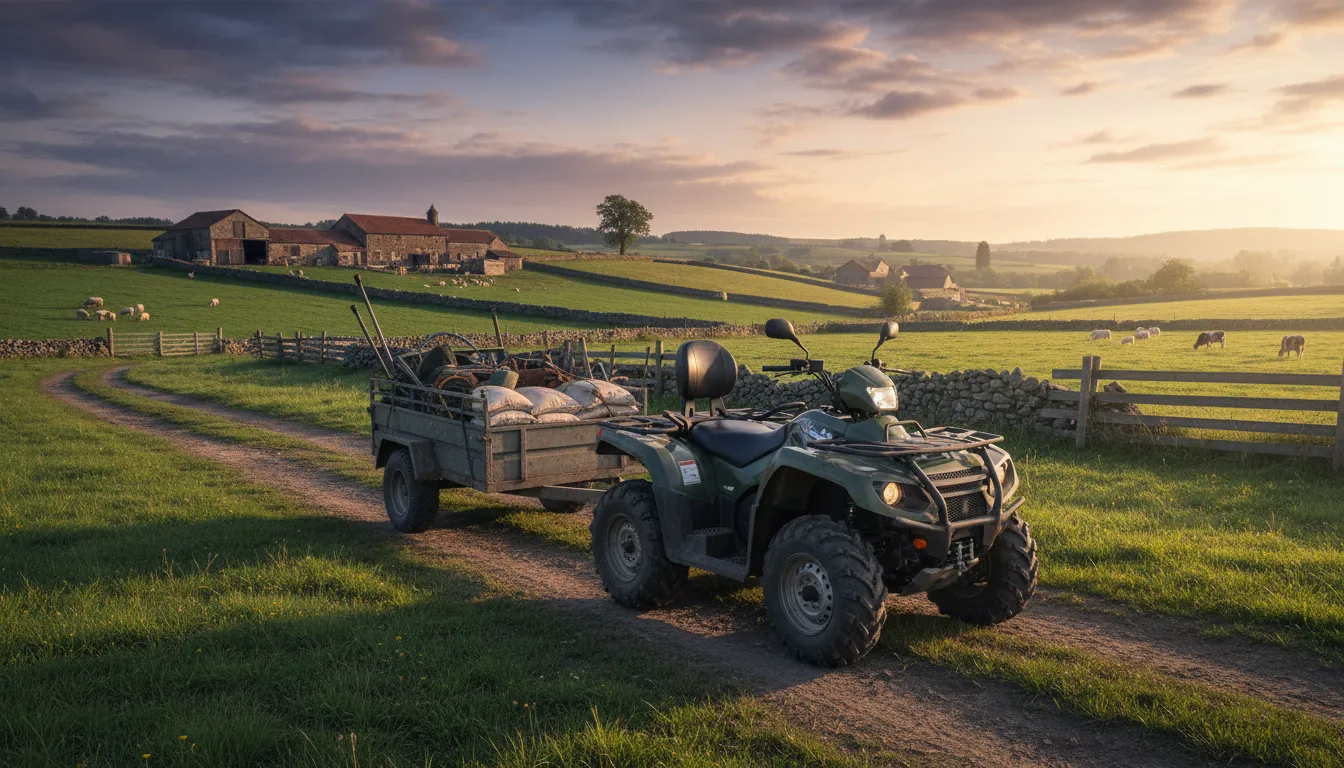
This is the single biggest reason farmers invest in ATVs. Checking herds spread across multiple paddocks, moving feed buckets and mineral blocks, monitoring calving or lambing ewes — all of it is faster on a quad. You cover ground quickly, you can reach animals in boggy areas where a tractor would get stuck, and you can carry what you need on the racks.
With a small trailer, an ATV like the GRIT 1000R can haul 500+ kg of feed or supplies in a single run. That's enough for most daily feeding operations without ever starting the tractor.
Fence Line and Property Inspection
After winter storms, heavy rain, or high winds, fence inspection is urgent. On foot, you're looking at hours. In a tractor, you're too slow and too wide for fence lines along woodland edges or steep paddock boundaries. An ATV lets you cover kilometers of fencing in minutes, with tools and repair materials on the rear rack.
Crop Monitoring and Field Scouting
Modern precision agriculture often starts with boots on the ground — or tires. Scouting fields for pest damage, checking drainage, monitoring crop emergence. An ATV gets you across 50 hectares faster than any other method short of a drone, and unlike a drone, you can stop, pull a soil sample, and move on.
Hauling Supplies and Tools
Fencing supplies, veterinary equipment, water troughs, salt licks, seed bags, spraying equipment — the daily list of things that need to move from point A to point B on a farm is endless. An ATV with a rear rack and trailer handles 90% of these without the overhead of starting a tractor.
Snow Removal and Winter Tasks
With a front-mounted plow blade, an ATV clears farmyard paths, access roads, and barn entrances faster than a tractor and far faster than a shovel. The GRIT 1000R's 92 HP and Visco-4Lok 4x4 system provides the traction and power to push through heavy snow without breaking a sweat.
Spraying and Seeding
ATV-mounted sprayer units (50-100 liter capacity) handle spot-spraying weeds, treating fence lines, or applying herbicide along ditches. Broadcast seeders mount easily to the rear rack for overseeding pastures. These aren't full-field operations — but they cover the 80% of spraying tasks that don't justify pulling out the big sprayer.
Why Engine Size Matters for Farm Work
Not all ATVs are built for farm duty. Understanding the difference saves you from buying a machine that can't handle the job.
Small ATVs (250-400cc)
Fine for a hobby property or light trail riding. But hitch a loaded trailer to a 300cc quad and ask it to climb a wet hill — you'll understand the limits quickly. Low torque, limited towing capacity, and engines that overheat under sustained load. These machines were designed for recreation, not work.
Mid-Range (500-700cc)
The starting point for genuine farm utility. Enough torque to tow moderate loads, decent ground clearance, and engines that can handle daily use. For flat terrain and lighter tasks, a 500-700cc machine works well. But push it into steep terrain with a heavy trailer, and you'll feel the strain.
High-Performance (800cc+)
This is where the BRCP GRIT 1000R sits — and for good reason. The 976cc V-twin engine delivers 92 HP and massive low-end torque. That means:
- Heavy towing without hesitation. 500+ kg towing capacity handles loaded trailers, timber, feed wagons, and equipment.
- Steep terrain under load. The V-twin doesn't struggle on grades that would stall a smaller engine.
- Mud and soft ground capability. Power reserves mean you don't get stuck — you power through.
- All-weather reliability. The engine runs well within its limits during daily farm use, which extends its lifespan dramatically compared to a smaller engine working at maximum capacity.
For a working farm, underpowering your ATV is a false economy. You'll work the engine harder, wear components faster, and eventually need a bigger machine anyway.
Key Features to Look for in a Farm ATV
4x4 with Differential Lock
Non-negotiable for farm use. Two-wheel-drive ATVs get stuck in the conditions you'll encounter daily — wet grass, mud, loose gravel, snow. The GRIT 1000R's Visco-4Lok system engages automatically when traction is lost and provides full locking capability when you need it. No stopping to flip a lever. No getting stuck halfway across a wet field.
Towing Capacity
Check the rated towing capacity, not the marketing claims. The GRIT 1000R is rated for 500+ kg, which covers most farm trailer applications — feed wagons, timber trailers, equipment carts, water bowsers.
Suspension
Farm terrain is rough. Ruts, rocks, roots, uneven ground — your ATV hits all of it, often at speed. Premium suspension travel (200+ mm) absorbs impacts that would rattle a lesser machine apart. This isn't about comfort — it's about the machine surviving years of daily punishment.
Reliability and Maintenance
A farm ATV runs every day, often in harsh conditions. Look for proven engine platforms, accessible service points (oil filter, air filter, CVT belt), and a dealer network that can supply parts quickly. Downtime during calving season or harvest isn't an option.
Storage and Rack Capacity
Steel racks front and rear, with rated load capacities. The ability to mount toolboxes, sprayer tanks, or cargo containers. If you can't carry what you need, you're making multiple trips — and that defeats the purpose.
Cost Comparison: ATV vs. Small Tractor for Daily Tasks
Let's put real numbers on it.
| Utility ATV | Compact Tractor | |
|---|---|---|
| Purchase price | 10,000-18,000 EUR | 25,000-45,000 EUR |
| Fuel consumption (light work) | 3-5 L/hr | 8-15 L/hr |
| Annual fuel cost (2 hrs/day) | 1,500-2,500 EUR | 4,000-7,500 EUR |
| Maintenance per year | 300-600 EUR | 1,000-3,000 EUR |
| Soil compaction | Minimal | Significant |
| Speed between fields | 60-80 km/h | 25-40 km/h |
Over a 5-year period, an ATV saves an estimated 15,000-30,000 EUR in fuel, maintenance, and time costs compared to using a compact tractor for the same daily tasks. And you still keep your tractor for the work that actually requires it.
The ATV doesn't replace your tractor. It replaces the second tractor — the one you've been thinking about buying for daily rounds and light tasks. At a third of the cost.
Farm Applications Across Europe
Poland
Polish farmers manage an average of 11 hectares, but many larger operations run 50-200+ hectares across fragmented plots. An ATV is ideal for moving between scattered parcels — something a tractor does slowly on public roads. Livestock farms in the Podlasie and Warmia regions increasingly use ATVs for daily herd management across rolling pastures.
Germany
German agriculture is highly mechanized, but even on large Bavarian or Lower Saxony operations, the ATV fills a gap. Foresters in the Mittelgebirge regions use them for woodland management. Dairy farms use them for pasture rotation and fence maintenance. The growing interest in precision agriculture — soil sampling, sensor deployment, field scouting — makes an ATV the practical tool for moving between data points.
Romania
Romanian agriculture is modernizing rapidly. Small and medium farms in Transylvania and the Banat region are investing in mechanization beyond the traditional tractor. ATVs offer an affordable entry point — lower fuel costs, easier storage, and the ability to handle the varied terrain of the Carpathian foothills where many mixed farms operate.
Slovakia
Slovak farmers in the Podunajská lowlands and the hilly regions of central Slovakia face diverse terrain challenges. From the flat arable land around Nitra to the mountainous pastures of Liptov, an ATV handles both extremes. The growing focus on livestock farming in upland areas makes a capable, high-traction ATV essential.
Attachments and Accessories That Transform Your ATV
The right accessories turn a utility ATV into a multi-purpose farm platform.
Must-Have Attachments
- Tow hitch and trailer — The single most important accessory. A rated tow hitch and a purpose-built ATV trailer handle 90% of hauling tasks.
- Front plow blade — Snow clearance in winter, grading tracks and fire breaks in summer.
- Winch — Essential for forestry work, recovering stuck equipment, or tensioning fence wire. A 2,500-3,500 kg winch covers most farm applications.
- Rear cargo box — Replaces the flat rack with an enclosed box for loose materials, tools, or small livestock supplies.
Specialized Equipment
- ATV sprayer unit (50-100 L) — Spot-spraying weeds, fence line treatment, pasture management.
- Broadcast seeder — Pasture overseeding, cover crop planting along field edges and waterways.
- Log skidding arch — Forestry and woodland management without heavy machinery.
- Water bowser trailer — Livestock water supply to remote paddocks.
Each attachment multiplies the ATV's utility. A single machine with 4-5 accessories replaces several single-purpose tools.
Making the Investment
Return on Investment
A farm ATV pays for itself through three channels:
- Fuel savings — 2,000-5,000 EUR per year compared to tractor use for the same tasks.
- Time savings — Faster transit, quicker task completion, more efficient daily rounds. Farmers consistently report saving 1-2 hours per day after adding an ATV.
- Reduced soil damage — Less compaction means better yields over time. This is the hidden ROI that doesn't show up on a receipt but shows up in crop performance.
For a machine costing 15,000-18,000 EUR, payback typically occurs within 2-3 years of daily farm use.
Why the GRIT 1000R for Farm Work
The BRCP GRIT 1000R was built for exactly this kind of daily, demanding use:
- 976cc V-twin, 92 HP — Power reserves for heavy towing and steep terrain without engine strain.
- Visco-4Lok 4x4 — Automatic traction management with full-lock capability. Works in mud, snow, wet grass, and gravel without driver intervention.
- 500+ kg towing capacity — Handles real farm trailers with real loads.
- Premium suspension — Survives years of rough terrain without constant repair bills.
- Built for daily operation — Not a weekend toy. An engine and drivetrain designed for thousands of hours of real work.
The farm doesn't wait for good weather. Your ATV shouldn't either. The GRIT 1000R handles every season, every terrain, and every task you throw at it — day after day.
For a deeper look at choosing the right engine size for your needs, see our complete buyer's guide. And once your ATV is working daily, our terrain maintenance guide will help you keep it running for years. Interested in the business side of ATVs in Europe? The market is growing fast.